



18 Sep, 2026
When Partial Modernisation Is Better Than Full Replacement
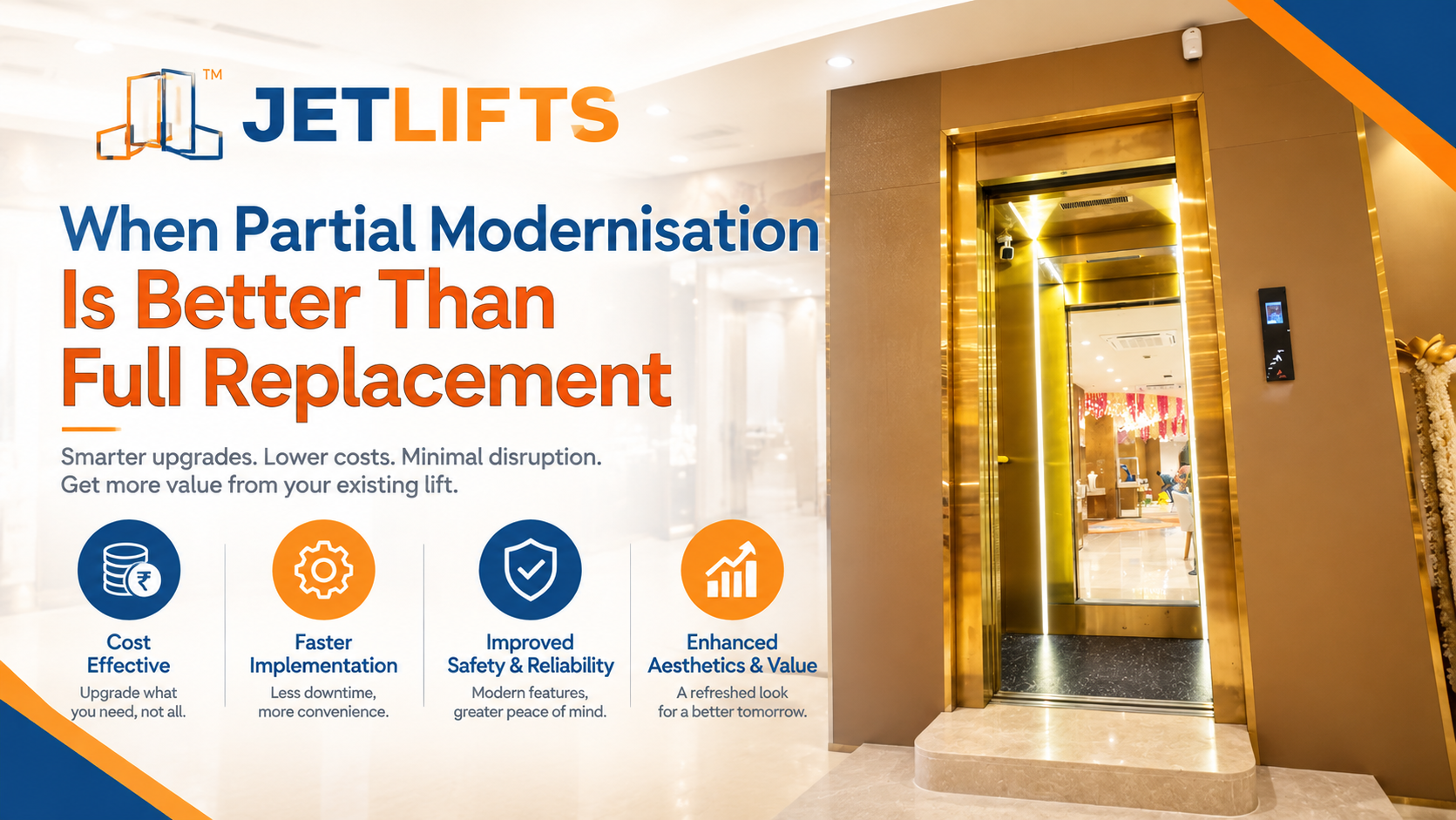
Partial elevator modernisation is the better choice when the hoistway, guide rails and car frame are sound, and the failures are concentrated in the controller, the doors or the machine. You replace the subsystems that have worn out, keep the structure that has not, and cut both the shutdown window and the bill against a full replacement.
Walk into a machine room in a fifteen-year-old apartment tower, and the story is usually the same. The rails are straight, the car frame is fine, and the complaint log is almost entirely doors and levelling. Nothing about that building calls for a new lift. It calls for a partial elevator upgrade aimed at three assemblies. Owners still get quoted full replacements, because a replacement is simpler to sell than a survey. Jet Lifts approaches lift modernisation as component work by default and moves to replacement only when the shaft forces it.
What Partial Elevator Modernisation Actually Covers
Partial elevator modernisation is the replacement of selected lift subsystems while the hoistway, rails and car structure stay in place. The usual scope covers one or more of these:
- Controller and drive: swapping relay logic or an obsolete solid-state board for a VVVF drive. This fixes levelling, ride quality and most intermittent faults in one go.
- Door operator and landing doors: the highest-wear assembly in any lift, and the source of most entrapment calls.
- Machine: rebuilding a geared unit or moving to a gearless machine where energy and noise matter.
- Safety gear, governor and buffers: the components an inspector will look at first at re-licensing.
- Car interior and fixtures: COP, LOP, lighting and cabin finish, which is where a customised elevator request usually lands.
That list is a menu rather than a package. Jet Lifts sells its modernisation kits as individually selectable components for this reason, so a society that needs doors and a controller does not pay for a machine it still has years of life in. The same logic applies across its residential lift range, where the platform stays and the components change.
Four Signs a Partial Upgrade Is the Right Call
Read your own maintenance log before you read a quotation. These four patterns point to elevator component replacement rather than a new lift.
- The faults cluster. Eighty per cent of your callouts trace to doors or to one control fault. Clustered faults mean a defined scope.
- Parts have gone obsolete, but the mechanics have not. Your technician is sourcing scavenged boards while the rails, ropes and car frame pass inspection without comment.
- The building is occupied and has one lift. A full replacement can take a single-lift tower out of service for weeks. An elevator retrofit of the controller and doors is measured in days.
- Capacity and speed still suit the building. Nobody is complaining about waiting times or a car that is too small, only about how the lift behaves.
When Full Replacement Wins Anyway
Some buildings cannot be fixed a component at a time, and pretending otherwise wastes money twice. Elevator modernisation vs. replacement turns on the shaft. If the hoistway is out of plumb, undersized for the capacity you now need, or was built to dimensions no current machine will fit, every partial scope you buy is a deposit on the replacement you will still do later.
|
The other case for replacement is a lift assembled from mismatched parts across three vendors. At some point the cost of making incompatible components talk to each other exceeds the cost of one engineered system. Jet Lifts covers this ground in its comparison of custom elevator engineering and standard packages.
How to Decide Without Guessing
Ask for four things before you sign anything, in this order.
- A written condition survey covering the hoistway, rails, ropes, machine, doors and safety gear, with a verdict on each.
- Your own fault history for the last twenty-four months, sorted by assembly.
- A scope priced line by line, so you can see what a controller costs against what doors cost.
- Confirmation of parts availability for whatever is being installed, and for how long.
If a vendor quotes a replacement without doing the survey, they have not earned the decision. The elevator modernisation options open to your building are set by measurements, and measurements take a morning.
Buy the Scope Your Building Needs
A partial elevator modernisation that fixes the doors and the controller will resolve more resident complaints than a full replacement that arrives eight months later. Match the scope to the fault log, phase the rest, and keep the structural work you already paid for once.
Send Jet Lifts your lift’s make, age, travel height and last two years of fault history, and ask for a surveyed scope with each subsystem priced separately. The team also builds MRL gearless systems and hydraulic lifts, so the recommendation is not tied to one technology. Speak to the Jet Lifts team to book the survey.
Frequently Asked Questions
How Much of a Lift Can Be Modernised Without Replacing It?
Everything except the hoistway, the guide rail alignment and the car frame can usually be replaced in stages. Controller, drive, machine, ropes, doors, safety gear and cabin are all candidates. Once the shaft itself is the limitation, you are into replacement territory.
Can Partial Modernisation Be Done in Phases?
Yes, and it is often the right way to fund it. Start with the controller and doors, then take the machine and cabin in a later phase. Agree on the phasing with one vendor, so the later stages stay compatible with the first.
Will a Partial Elevator Upgrade Extend My Lift’s Licence?
It does not extend anything automatically. In most Indian states, an alteration to a licensed lift needs prior written permission and a fresh inspection before the lift returns to service. Plan the approval time into the shutdown rather than after it.
Does Modernisation Let Me Change the Cabin Design?
Yes. Cabin finish, lighting, COP and LOP fixtures are among the easiest items to change, which is why most owners who want to customise elevator interiors do it during a modernisation rather than as a standalone job.